
Bringing common sense with a grain of salt back to parenting!


QUICK READ
THE ISSUE
A flawless parent is a mythical creature, somewhere as probable as meeting Bigfoot in a park or having a full night’s sleep with a newborn in your room — often discussed, never confirmed.
And yet, we often feel that parental authority requires us to act as if we know what we’re doing at all times. So we are sometimes tempted to pretend we do. Misremember a deadline? Blame the teacher. Get lost on the way to soccer? “This is the more beautiful and scenic route.” Lose your temper? Explain why they made us do it.
The thing is ... tweens notice. They’re remarkably good hypocrisy detectors.
Pretending you’re always right doesn’t protect your authority. If anything, it can undermine it.
WHY WE GET PULLED IN
The instinct is understandable. Parents are supposed to be reliable. We make decisions, set limits, settle arguments and supposedly know which drawer has the AAA batteries, and where the new brush for cleaning braces is.
Admitting “I was wrong” can therefore feel strangely risky. If I admit one mistake, will my authority crumble and they will start questioning everything?
Also, many parents grew up with a model of parental authority in which adults rarely apologized to children. “Because I said so” ended the discussion.
And then there’s ordinary human ego. Being wrong is annoying. Being proven wrong by someone who still doesn’t put their shoes away when they get home is particularly annoying.
HOW IT CAN BACKFIRE
When children watch us deny obvious mistakes, spin excuses or produce apologies ending in “but you…”, they notice the contradiction between what we demand from them and what we permit ourselves.
That can erode credibility and fuel resentment. More importantly, it models exactly the response we probably don’t want from them: when caught being wrong, defend yourself rather than own it.
It can also make mistakes seem more threatening than they need to be. If adults must never be wrong, perhaps being wrong really is something shameful.
WHAT ACTUALLY MATTERS
Parental authority does not require infallibility. Children need parents who are dependable, fair and willing to make decisions — including decisions their children dislike. Admitting that you got something wrong does not mean surrendering your role.
In fact, there is an important difference between:
“I was wrong about that.”
and:
“Therefore from now on you get to decide everything.”
You can apologize for yelling and still enforce the bedtime.
STEPPING OUT OF THE TRAP
Start small. Say, “I gave you the wrong time. Sorry.”
Ditch the “but”. “I’m sorry I yelled, but you were being difficult” isn’t much of an apology.
Correct what can be corrected. Laugh at harmless mistakes. And when your tween admits one of theirs, make sure they remember honesty is safe and better than denial.
THE BOTTOM LINE
The goal isn’t to turn into an endlessly apologizing parent who second-guesses every decision.
It’s much simpler: when you’re wrong, be willing to be wrong.
Authority doesn’t come from pretending you never make mistakes. It comes from being trustworthy enough to admit them.
FULL TEXT ARTICLE
THE ISSUE
A flawless parent? A a mythical creature, somewhere between Yeti and Loch Ness monster — often discussed, never confirmed.
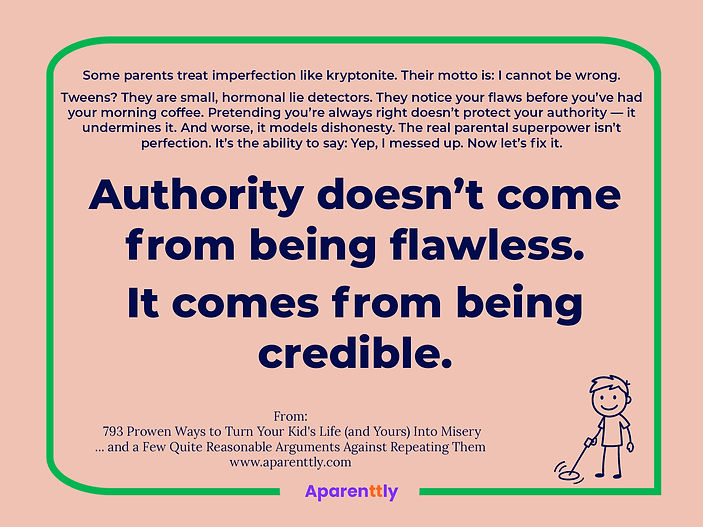
Some parents treat imperfection like kryptonite: I cannot be wrong, because I am the Parent, capital P.
But tweens? They are small, hormonal lie detectors. They notice your flaws before you’ve had time to come up with a convincing answer.
Pretending you’re always right doesn’t protect parental authority — it undermines it. And worse, it can model exactly the kind of behaviour we usually want children to avoid.
The real superpower for parents isn’t perfection. It’s being able to say: Yep, I messed up. Now let’s fix it.
Picture this: you’re at dinner, confidently explaining how Mount Everest is the tallest mountain in the world by distance from the base to the summit. Your tween whips out their phone mid-bite, fact-checks you, and announces: “Actually, Mauna Kea is taller from base to summit. Everest just has higher elevation.”
Boom.
You could say, “Wow, I didn’t know that — thanks for telling me.”
But instead, you hear yourself muttering:
“Well, technically, I meant…”
Congratulations. You’ve just lost two points in both geography and credibility.
Few things sting quite like being wrong in front of your own child. You’re supposed to be the wise elder, the keeper of secrets, the one who knows which drawer has the AAA batteries and how to fold a fitted sheet perfectly.
So instead of admitting it, we sometimes double down.
The instinct is understandable. You want to look reliable, in control and respectable.
But tweens aren’t fooled. They see you squirm. They see you spin. And they file it away in the growing mental folder labeled Reasons My Parents Are Sometimes Not To Be Trusted.
WHY WE GET PULLED IN
Parents sometimes cling to perfection simply because the alternative can feel surprisingly risky.
Fear of Losing Authority. “If I admit I was wrong, won’t they stop listening?” We worry that one admission of fault will unravel the fragile sweater of parental authority, leaving us standing there in metaphorical underwear.
Cultural Conditioning. Many of us grew up in households where “Because I said so” ended every debate. Parents didn’t necessarily explain themselves, and apologies from adults to children weren’t always part of the family vocabulary.
Ego Preservation. Let’s face it: being wrong feels terrible. Admitting it can feel worse. Especially if it’s in front of someone half your size who still can’t remember to put socks in the laundry basket.
Misunderstanding Leadership. We can confuse authority with infallibility. We think being the adult means always having the answer, when good leadership also includes recognizing mistakes and correcting them.
Habitual Spin Doctoring. Some of us have perfected the art of “creative reframing.” We don’t say we were wrong — we say, “Ah, but that’s another way of looking at it.”
And modern parenting adds an interesting complication.
Parents are constantly being told how consequential their choices are: use the right discipline strategy, communicate correctly, set the right boundaries, regulate your emotions, model the right behaviour. Much of that advice is sensible. Taken together, however, it can create another impossible standard: the emotionally intelligent parent who responds correctly to everything.
So admitting that we handled something badly can feel like admitting that we have failed some larger parenting test.
We haven’t.
Parents make bad calls sometimes. We sometimes misunderstand situations. We sometimes lose our patience. We sometimes remember things incorrectly. We occasionally give advice that turns out to be nonsense.
That isn't a sign of a broken parenting.
It's about being human.
HOW IT CAN BACKFIRE
When parents never admit fault, kids don’t just roll their eyes. They can absorb some unhelpful lessons about honesty, humility and what people are supposed to do when they get something wrong.
It Undermines Trust. Kids notice. If they see you deny mistakes they know happened, they start questioning your credibility. If Dad won’t admit he burned the cookies, his insistence that the oven somehow “runs unusually hot today” isn’t helping.
It Models Denial. If our response to being wrong is to deflect, explain away or blame someone else, we shouldn’t be too shocked when our tween tries exactly the same strategy.
It Fuels Resentment. Nobody enjoys being around someone who is “always right.” Tweens especially. One set of rules for children and another for adults is fertile ground for arguments about fairness.
It Can Make Mistakes Feel Shameful. If the adults in the family must always appear correct, children can absorb the idea that mistakes are something to hide rather than something to acknowledge and repair.
It Weakens Problem-Solving. Admitting a mistake is often step one in fixing it. I got this wrong. What do I do now? is a much more useful life skill than How can I prove that technically I wasn't wrong?
It Costs Opportunities for Connection. Showing that you can be imperfect without collapsing into shame gives your child permission to do the same.
There is also a credibility problem. Tweens are old enough to recognize inconsistencies and to be spectacularly unimpressed by adult spin.
And today they can fact-check us. Instantly.
Previous generations of parents could confidently invent an answer and perhaps remain undisputed until the encyclopedia came down from the shelf. Today your child can ask Google or ChatGPT before you've finished the sentence.
Parental omniscience was always an illusion. Technology has simply shortened its life expectancy.
WHAT ACTUALLY MATTERS
The alternative to pretending we’re always right is not abandoning authority.
This distinction matters.
Children still need adults who make decisions. Parents know things their 12-year-olds don't. Experience matters. Judgment matters. Rules matter. And sometimes the right answer must be: No.
Your child disagreeing with a decision does not mean you owe them an apology for making it.
Likewise, being open to admitting mistakes does not require turning every family disagreement into a courtroom in which your tween cross-examines you until you concede.
Authority and humility can comfortably live in the same house.
You can say: “I was wrong to yell at you.”
and then: “The rule about coming home at nine still stands.”
You can say: “I misunderstood what happened. I'm sorry I accused you.”
without saying: “Therefore I will never question you again.”
And you can say: “I still think this is the right decision, even though I understand why you don't like it.” without pretending that parental authority depends on winning every argument.
What genuinely matters is credibility.
Children gradually learn whether the adults around them can distinguish between being responsible and being infallible.
A parent who can say “I got that wrong” demonstrates something important: being mistaken doesn't make you weak, stupid or unworthy of respect. It simply gives you something to correct. And this is a very valuable life lesson for kids.
STEPPING OUT OF THE TRAP
Remembering that authority isn’t about being perfect isn't a declaration of surrender. It’s a reminder that parenting is about being credible.
Here are some ways to step down from the imaginary pedestal of being flawless without collapsing into chaos.
Start Small. Admit harmless mistakes: “I told you the wrong time,” or “Oops, I thought we had eggs.” This normalizes imperfection without drama.
Ban the “But” Apology. “I’m sorry I yelled, but you…” cancels itself out. The “but” is just ego sneaking back in. Try: “I’m sorry I yelled. That wasn’t fair.”
Apologize for What Was Actually Wrong. You don't have to apologize for the rule when the problem was how you enforced it. “I shouldn't have shouted” is different from “You were right about bedtime.”
Model Self-Correction. Show what learning looks like: “I thought staying up late would be fine, but you're exhausted today. That clearly didn't work. Next time, earlier bedtime.” You’ve admitted the mistake and shown the fix.
Tell Stories of Past Failures. Share your childhood disasters — the failed test, the fashion choice, the embarrassing crush. Kids laugh, but they also learn: mistakes don’t ruin you.
Celebrate Their Honesty. When they admit a mistake, don’t immediately pounce. “ I appreciate you telling me the truth” doesn't mean there can’t still be consequences. It means honesty itself matters.
Reframe Authority. Stop equating perfection with power. Credible authority grows from fairness, consistency, judgment and trust — not from maintaining the fiction that the parent never gets anything wrong.
Watch the Spin. Notice when you’re “reframing” instead of admitting. Catch yourself turning “I was wrong” into “That’s not what I meant.” Then rewind and say the real thing.
Laugh at Yourself. Humor disarms shame. Admitting “Well, I totally messed that up!” with a grin makes humility look strong, not weak.
And perhaps most importantly, don't turn apologizing into another parenting performance.
You don't need a six-step repair ritual every time you buy the wrong cereal.
Sometimes: “Oops. My mistake.” is plenty.
THE PAYOFF
When you admit mistakes, you don’t have to lose authority. You can gain credibility.
Trust builds. Kids learn that your words matter because you are willing to own the uncomfortable ones too.
Honesty becomes safer. They see that admitting a mistake doesn't end the world.
Resentment has less fuel. There is less need to prove that the parent is being hypocritical when the parent is capable of noticing it too.
Standards shift. The goal becomes less about appearing perfect and more about taking responsibility, correcting what can be corrected and moving on.
The irony is simple: pretending you’re always right can weaken the very authority you're trying to protect.
Admitting you’re wrong can strengthen it.
Someday, your child will screw up — at school, at work, in friendship, in love. We cannot guarantee how they will respond. But we can give them a useful model of what responsible adulthood looks like:
I got this wrong.
I'm responsible for my part.
What can I do to make it better?
And someday, when they stand in front of their own tween, perhaps they’ll know the secret:
Some of the most powerful words in parenting aren’t “Because I said so.”
They’re: “You’re right about this — I was wrong.”
© Kristijan Musek Lešnik, 2025

