


The "All-or-Nothing Rule Enforcer" Trap

Some parents forget that progress beats perfection and turn their household into the "The All-or-Nothing Rule Enforcrcing empire". In the short term, this may yield results, but in the long term, cultivating an authoritarian parenting approach usually backfires.
“Rules work best when they’re consistent and flexible enough to make sense.”
Rules are supposed to keep order. But when they harden into absolutes — enforced with the flexibility of a medieval stone wall — kids don’t learn respect, they learn resentment (and loopholes). This chapter explores the parental trap of “all-or-nothing” enforcement, why it’s tempting, how it backfires, and how to keep rules meaningful without turning family life into a courtroom drama.
Parenting mistake: Expecting perfection or complete failure — nothing in between.
THE ISSUE
Rules matter. They keep kids from licking the dog’s water bowl or juggling knives. But when every rule is enforced with the flexibility of a brick wall, parenting turns into a courtroom drama.
Bedtime is always 8:30 — even on vacation. Chores always come before play — even if it’s about to rain. A task is either fully done or worthless.
To parents, this feels like strength. To kids, it feels like nitpicking. And instead of learning respect, they often learn resentment — or sneakiness.
WHY PARENTS DO THIS
Fear of the slippery slope. Bend one rule and suddenly the kids are running underground fight clubs in the basement.
Consistency = control. We’ve been told kids thrive on consistency, so we cling to it like a life raft.
Ego. Sometimes it’s less about the rule, more about “winning” the interaction.
Comfort of absolutes. Gray areas are messy. Absolutes are easier.
And, let’s be honest, there’s a small thrill in declaring, “Because that’s the rule!”
HOW THIS HARMS KIDS (AND PARENTS)
Rigid rule enforcement isn’t just exhausting — it’s counterproductive.
Kills adaptability. Life is full of exceptions. Kids need to practice navigating them.
Damages trust. If rules don’t make sense, kids stop respecting them — and you.
Creates resentment. Bedtime becomes a symbol of oppression, not rest.
Encourages sneakiness. If negotiation is impossible, secret rebellion becomes tempting.
Flattens priorities. If “don’t touch the hot stove” gets the same intensity as “finish your peas,” kids can’t tell the difference.
The subtle harm? When everything is urgent, nothing is. Rules lose meaning.
AVOIDING THE TRAP
Rules are essential, but they work best with a little common sense.
Rank Your Rules. Not all rules are equal. If everything is “life or death,” kids stop listening. (Some rules should remain non-negotiable: safety, respect, health. Others can be negotiable: bedtimes on vacation, dessert on birthdays.)
Make Exceptions, But Name Them. Don’t quietly ignore the rule. Say: “Usually bedtime is 8:30, but since Grandma’s here, we’ll stay up.” This way flexibility looks intentional, not random.
Use Context as a Teaching Tool. Show them why exceptions happen: “Normally chores come first, but since it’s raining, you can swap the order today.” You’re modeling adaptability, not chaos.
Don’t Flex for Power. If you’re digging in just because “that’s the rule,” check yourself. Is this about their growth or your pride?
Invite Input. Kids are more likely to follow rules they helped shape. Let them weigh in on bedtime tweaks or chore swaps. Buy-in reduces battles.
Praise Progress. Celebrate effort. “You folded 12 shirts — great job.” Don’t let the missing three overshadow the accomplishment.
Model Flexibility Yourself. Canceling a picnic because of rain and pivoting to movie night shows kids that bending isn’t weakness — it’s wisdom.
MISTAKES TO AVOID
Enforcing every rule with equal force.
Making exceptions but pretending you didn’t.
Treating broccoli like it’s as serious as fire safety.
Missing teachable moments about nuance.
THE PAYOFF
When you stop being an all-or-nothing enforcer, rules regain their meaning.
For kids: They see boundaries as helpful, not punitive. They learn nuance, adaptability, and respect.
For parents: Fewer power struggles. Less sneaky rebellion. More cooperation.
And maybe the next time Grandma offers them a cookie before dinner, you’ll say yes — not because you’ve lost control, but because you’ve gained perspective. Because parenting isn’t about enforcing every rule to the letter. It’s about teaching kids why rules matter — and when they can bend without breaking.
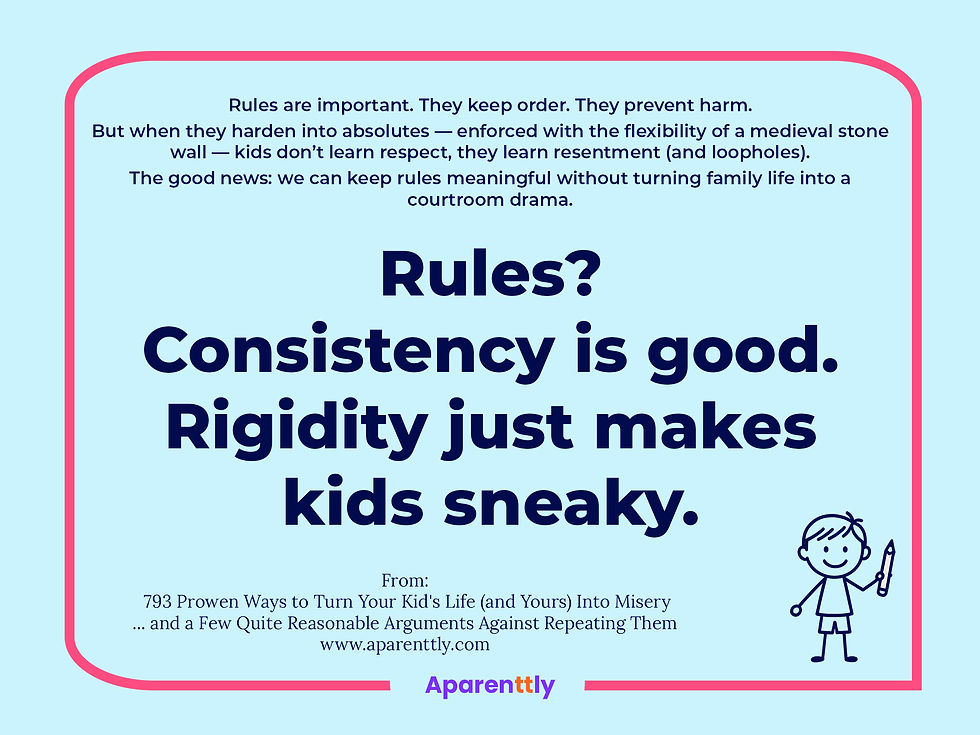
Celebrate the 12 shirts folded, not the 3 left in the pile. Flexibility isn’t failure — it’s teaching life skills in real time. When flexibility vanishes, kids don’t learn respect — they learn resentment. Rigid rules don’t build respect. They build resentment… and sneaky loopholes. Flexibility isn’t weakness. It’s wisdom. Kids need to see rules bend when context changes.
© dr. Kristijan Musek Lešnik & Aparenttly. All text and visuals are original works.
Sharing is welcomed. Reposting or reproduction without credit is not permitted. Please tag @Aparenttly when sharing.


Comments