


The "Grade-Obsessed Parent" Trap

All kids come to an age when grades start to feel more “real.” Report cards have letter grades instead of sunshine stamps. Standardized testing ramps up. And parents… well, some of us start treating every test score like a financial forecast.
“Learning is a process, not a performance. When grades become the currency of parenting, kids may cash out on curiosity altogether.”
You think you’re encouraging achievement. But when every quiz, essay, or spelling test gets analyzed like stock prices on Wall Street, your child doesn’t feel motivated — they feel like a company under hostile takeover. Let's look into how we got so grade-obsessed, what it does to kids, and how to build a healthier approach to learning that values growth over graphs.
Mistake: Treating grades as the only measure of worth.
THE ISSUE
Your child brings home a test. Instead of “Nice work,” you’re already calculating their GPA trajectory like you’re on Wall Street.
One B-minus feels like a market crash. One missed assignment sparks a full family board meeting. And thanks to those grade apps, you get real-time push notifications of academic disaster: “Math quiz: 73%.” Cue parental panic at 2:17 p.m.
The message your tween hears? “My worth is a number. And if that number drops, so does my value.”
WHY PARENTS DO THIS
We’re not monsters — we care. But our good intentions get tangled in fear, competition, and control:
Future anxiety: We picture one missed quiz leading to a lifetime of missed opportunities.
Comparison culture: Social media shows everyone else’s honor roll certificates.
Our own past: Maybe grades were how we earned love — so we repeat the cycle.
Control illusion: Numbers feel measurable, unlike curiosity or resilience.
School systems: Honor rolls, test prep, GPA rankings — the machine feeds obsession.
Grades feel like the safest way to track progress. But safe doesn’t mean healthy.
HOW THIS HARMS TWEENS (AND PARENTS)
When grades are the only scoreboard, the costs go deeper than a disappointing report card, because it:
Kills curiosity: “Will this be on the test?” becomes their default question.
Fuels perfectionism: Fear of failure trumps risk-taking and growth.
Links self-worth to scores: A 72% feels like a personality flaw.
Damages trust: If every car ride is a grade debrief, they clam up or hide info.
Encourages shortcuts: If only the A matters, honesty takes a back seat.
Burns them out: Anxiety and stress pile up before high school even starts.
Worst of all, they may believe your love depends on numbers — not who they are.
AVOIDING THE TRAP
You don’t need to ignore grades. Just don’t treat them like Wall Street data.
Shift the conversation. Swap “Why only 82?” for “What was hardest about it?” Curiosity over judgment keeps dialogue open.
Celebrate effort, not just outcomes. Praise perseverance, focus, or creative strategies. Grades measure the result, not the grind.
Normalize mistakes. Failure = feedback. Share your own “flops” to prove learning doesn’t require perfection.
Cut the portal patrol. Checking grades daily? Stop. Weekly is plenty. Constant alerts turn you into a GPA day trader.
Separate scores from self-worth. Say often: “I love you no matter what’s on the paper.” And back it up with your reactions.
Redefine success. Grades matter, yes — but so do kindness, teamwork, creativity. Notice those equally.
Choose your battles. Not every quiz needs a family summit. Save pressure for big values: safety, honesty, respect.
Invest in curiosity. Museums, YouTube rabbit holes, kitchen science experiments — remind them learning happens outside tests.
THE PAYOFF
Kids aren’t stocks. They’re humans in the making. And the real investment is in who they’re becoming — not just what they’re scoring.
When you step back from grade-obsession, homework stops feeling like a nightly stock market crash. Your tween starts to see grades as feedback, not destiny. They build resilience, curiosity, and confidence that isn’t chained to a number.
And you? You get a calmer house, fewer car-ride interrogations, and a relationship that isn’t built on GPA reports.
Years from now, your child won’t remember whether they got an 89 or 91 in seventh-grade algebra. But they will remember if you loved them through both.
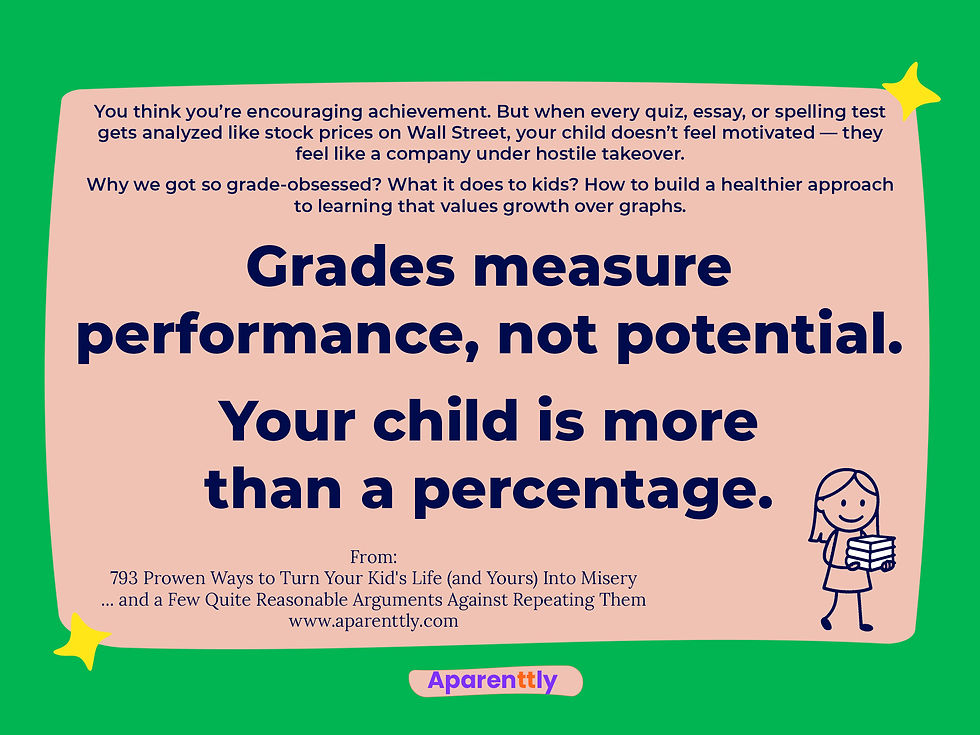
Grades measure performance, not potential. Your child is more than a percentage. Grades measure performance, not potential. Your child is more than a percentage. Grades measure performance, not potential. Your child is more than a percentage. Grades measure performance, not potential. Your child is more than a percentage.
© dr. Kristijan Musek Lešnik & Aparenttly. All text and visuals are original works.
Sharing is welcomed. Reposting or reproduction without credit is not permitted. Please tag @Aparenttly when sharing.


Comments